Why Airflow and Shade Matter More Than Solid Walls in a Livestock Shed
As summer approaches across much of Australia, producers and hobby farmers start to think about heat as much as rain. Animals in an uncovered yard can suffer heat stress, and animals in a closed building can suffer from stale, humid air. A livestock corral panel metal shed sits between those two extremes, with a roof overhead and open fencing at the sides. That combination is a deliberate design choice, and the useful questions about any livestock shed concern heat, air movement, handling, and space rather than how solid the walls look.
Heat Is Blocked, Moved, or Stored, and a Shelter Must Choose
A shelter can deal with heat in three basic ways. It can block sunlight with a roof, it can move air through the space so warm air is replaced, or it can store heat in heavy material and release it later. A light steel structure relies on the first two.
A wide-brimmed hat is a good picture: it shades the head while air still moves around it. A car parked in the sun does the opposite and traps heat because nothing carries it away. A cattle shed or any livestock shelter should behave like the hat, not the car.
A Metal Roof Shades the Animal but Warms the Air Beneath
Corrugated steel is strong and sheds rain well, but it absorbs sunlight and warms up, and a dark roof colour absorbs more than a light one. The warm roof then radiates heat downward onto the animals beneath.
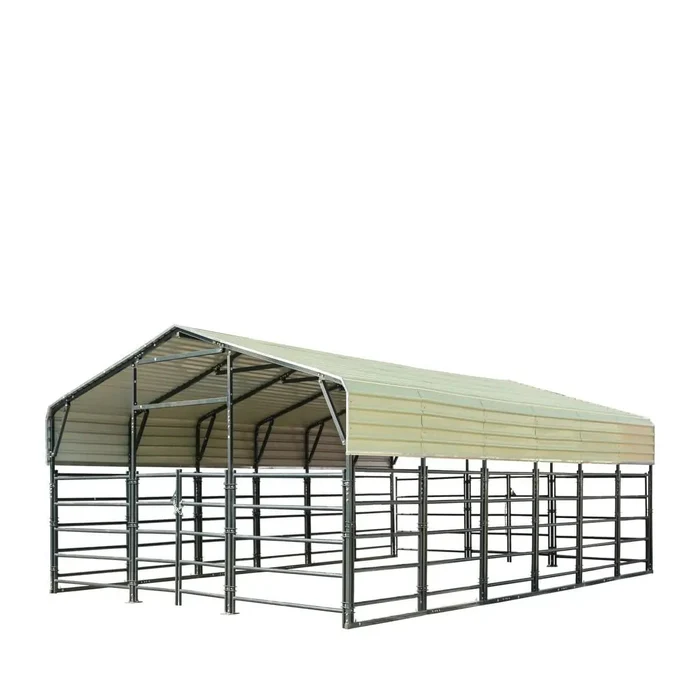
The remedy is air movement beneath the roof. The TMG-MS2030LC has sidewalls 2.2 metres high and a roof pitched at 15 degrees, so warm air can rise under the slope and drift out, drawn along by any breeze.
Open Fencing Lets Air Through While Keeping Animals In
The sides of this shed are open five-bar fencing panels 1.5 metres high rather than solid cladding. Air passes through them freely, which also helps moisture and ammonia from manure disperse instead of building up. Poor ventilation is a common cause of respiratory problems in confined animals, so this is a health point as well as a comfort point.
Open panels also keep sight lines clear, so handlers can check animals from outside and animals can see their neighbours, which many people find helps stock stay settled. The trade-off is less protection from driving rain and cold wind, so it suits warm, mild conditions better than exposed, wet sites.
Gates and Pen Layout Decide How Safely Animals Move
Two swing gates, each 1.9 metres wide and 2.2 metres high, sit at opposite ends. Having an entry and an exit lets animals move through in one direction rather than turning back on themselves, which lowers the chance of crowding and of a handler being cornered.
The same structure can be used in several ways, and the intended use shapes how the pen is laid out, how much room each animal needs, and where feed and water points should be placed inside it:
• Housing: shade and rest during hot spells
• Feeding zone: contained, dry feeding area
• Quarantine: separate area for new or sick animals
• Equipment store: covered space for tools and feed
Space per Animal Sets the Real Limit
This livestock shed has a covered floor area of 56 square metres. That figure is a ceiling, not a stocking recommendation. How many animals it can safely hold depends on the species, their size, and the conditions, and welfare standards for each species differ between states. Check the guidelines that apply to your animals before deciding how many to place inside. A crowded shelter raises heat, humidity, and the risk of injury, and a quarantine area needs more room again. Size the structure for the hottest, busiest day rather than the average one.
The Frame and Foundation Keep the Structure Honest
The frame of this livestock shed is made from galvanised steel tube, 50 millimetres square, with powder coating over the zinc layer. Galvanising protects against corrosion, which matters because manure and moisture attack bare steel quickly. Slip-fit tube connections with bolt-secured braces hold the frame together.
The structure needs a level foundation area of about 6.1 metres by 9.2 metres. At roughly 1,000 kilograms, the packed shed is also too heavy for tailgate delivery, so a forklift or equivalent machine is needed to unload it.
Planning for the Hottest Day, Not the Average One
Many Australian regions are seeing hotter summers, so shade and airflow are likely to matter more to livestock owners in the years ahead, and a shelter that keeps the roof overhead and the air moving suits that direction well. When comparing any livestock shed, ask how it deals with heat, where the air goes, how animals enter and leave, and how much space each animal really has. TMG Industrial supplies this corral panel design for owners who want a shelter that answers those questions without relying on solid walls.