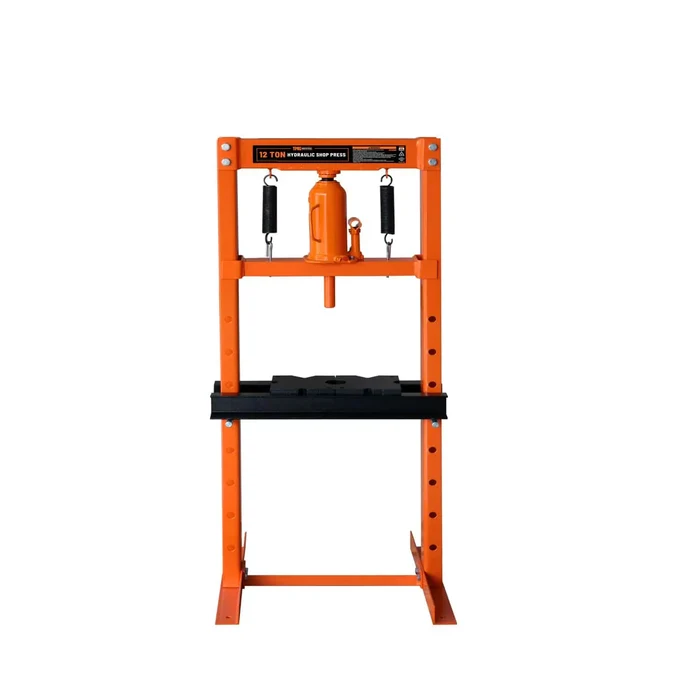
On a Bottle Jack Press the Jack Itself Is the Limiting Component
On a Bottle Jack Press the Jack Itself Is the Limiting Component
Tonnage is how presses are sorted on a shelf, and on a hand operated machine the rating describes one part rather than the whole. Twelve tons is what the jack can produce. Everything about how the press works day to day is decided by the same jack, and mostly by the part of it nobody looks at. A 12 ton hydraulic shop press is best understood through its stroke.
Stroke is a short number with long consequences
The jack on a 12 ton press typically offers somewhere between four and six inches of ram travel. That is the total travel available in one continuous operation, and it covers the gap above the work, the pressing distance, and the clearance to get the tool back out. Pressing a bearing a quarter of an inch sounds comfortable inside six inches of stroke. It stops being comfortable when two inches of that stroke were consumed just reaching the workpiece.
Re stroking is the operation nobody plans for
When the ram runs out of travel mid job, the jack has to be retracted and something packed underneath to take up the gap. That means releasing the load on a part that is halfway through moving, which is the least desirable moment to let go of anything.
The packing then becomes a structural component. A stack of spacers inserted under pressure carries the full twelve tons, and anything in it that is not flat, square and sized to the job is a sideways force waiting to happen.
Eight bed positions exist to recover stroke
Moving the bed is the answer to a problem the bottle jack press cannot solve on its own. Each pin position repositions the work closer to the retracted ram, which spends bed adjustment instead of spending stroke. Choosing the highest bed position that still clears the work is what makes a hand press pleasant to use. It leaves the maximum ram travel available for the part of the job that actually needs it, and it removes most re stroking entirely.
Why a hand crank changes where you stand
A lever pump on an h frame press puts the operator beside the ram, reaching in. The crank version on this type of frame moves that effort to a position where the operator is not leaning across the ram line, which matters because the ram line is where a hardened component goes when it finally releases.
The mechanical advantage is lower per stroke and the pumping is steadier. Steady is the useful property on an unknown seized part, since the resistance change travels back through the handle and tells the operator what is happening before anything is visible.
What the gauge is really telling you
Pressure rising while nothing moves means energy is accumulating in the workpiece and the frame. The gauge measures hydraulic pressure and shows it as tons, which assumes the force acts straight down the ram axis.
Four checks keep that assumption true:
• Work square and supported on both bed rails
• Both bed pins seated in matching holes
• Press plates sized to the part, not the bed
• Ram centered over the point being pressed
The third one causes the most trouble on a bottle jack press, because the bed rails invite using the full width. Press plates set too far apart let a part flex between them, and the gauge reading then describes how much the workpiece is bending rather than how hard it is being pressed.
Where a hand press beats a powered one
Slow is a feature on repair work. A hand pump cannot overshoot, so a bushing that starts moving unexpectedly moves a fraction of an inch rather than leaving the far side of the housing. It also needs nothing but floor space. No compressor, no three phase supply and nothing to fail between jobs, which suits a shed that presses a dozen parts a year rather than a dozen a day.
Maintenance on a jack that sits unused
A jack left with the ram extended corrodes on the exposed surface, and that corrosion then passes straight through the seal on the next stroke. Stored fully retracted, the ram sits protected inside the body of the jack.
Air in the system is the other recurring complaint. A jack that feels spongy or lifts partway and stops usually needs bleeding rather than replacing, which is a few minutes with the filler plug and the ram fully down.
Reading a specification past the tonnage
On a bottle jack press, capacity, frame width and overall height describe what fits. Ram stroke, the number of bed positions and the pin diameter describe how the press behaves on the jobs that do not fit neatly. TMG Industrial builds this one as an H frame with a hand crank bottle jack and eight bed height positions. Measuring the tallest assembly you expect to press, and then checking it against stroke rather than against tonnage, is the calculation that decides whether the press suits the work.